Physical transparency
Works from seismic energy released by historical events, making the analysis traceable to observed regional behavior.
Seismic Energy Release Risk Assessment — a physics-based framework that analyzes earthquake catalogs in the physical domain of released tectonic energy, not only in the compressed domain of magnitude.
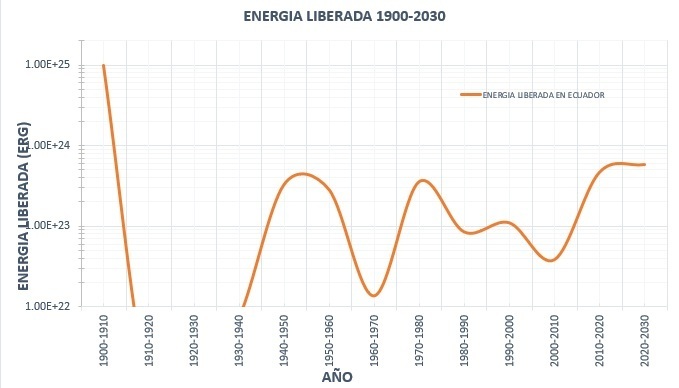
Magnitude is logarithmic. It compresses the physical reality of seismic energy. SERRA/MEL reverses that compression by transforming historical seismic catalogs into energy release histories, allowing reactivation stages, dominant seismic sources and engineering-relevant risk parameters to emerge from the region’s own record.
The updated national map presents SERRA as a modern spatial framework for visualizing where seismic energy has been concentrated across Ecuador and how that concentration can inform planning, engineering and risk management.
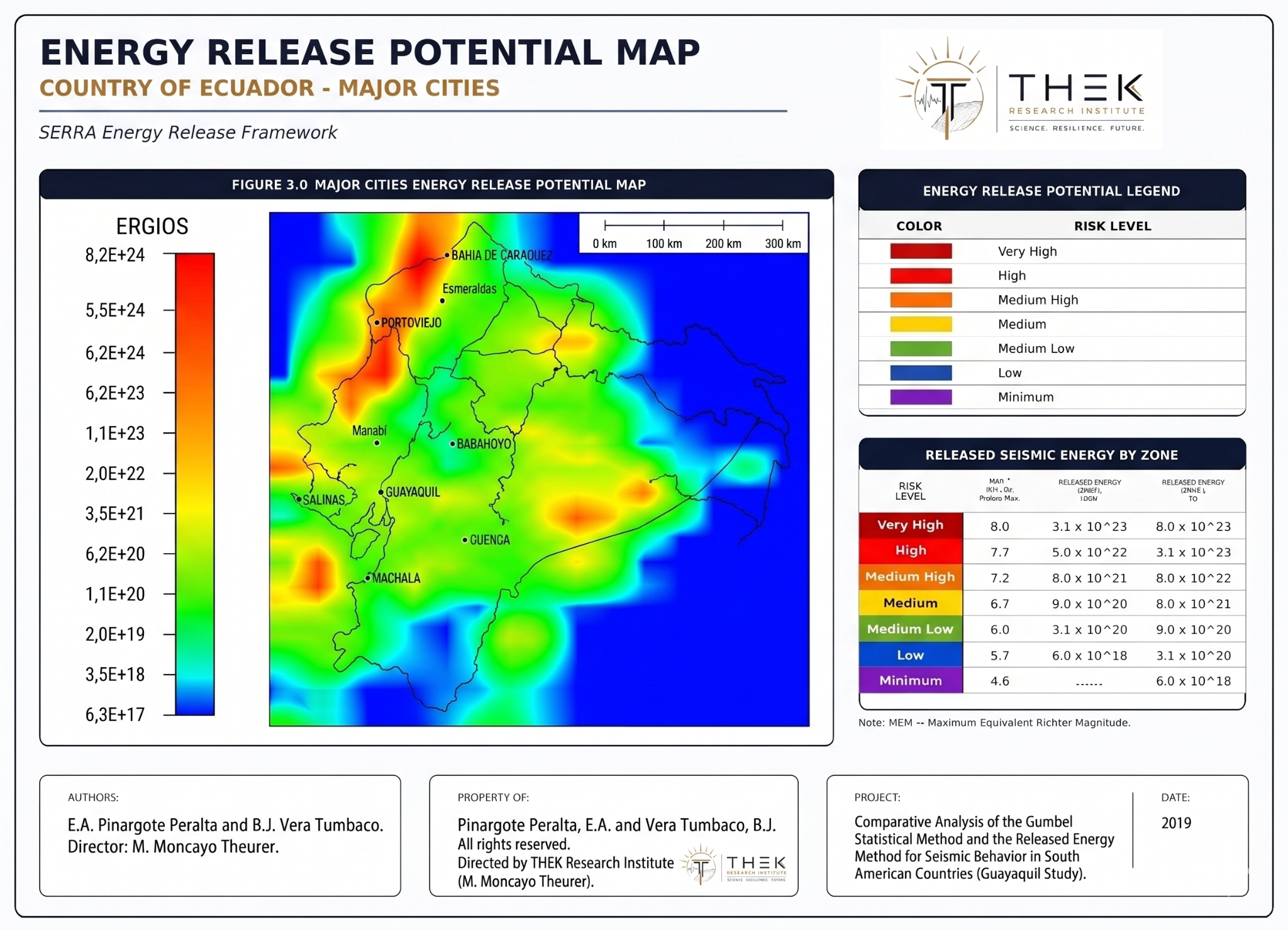
Works from seismic energy released by historical events, making the analysis traceable to observed regional behavior.
Identifies periods of increased seismic energy release and distinguishes them from recharge or lower-activity phases.
Translates energy concentration into spatial maps useful for national, municipal and infrastructure-level planning.
Aggregates complex fault networks into integrated seismically active systems that can be analyzed over time.
Connects released energy to equivalent magnitude, attenuation laws, design acceleration and seismic design decisions.
Can be updated as new catalog data become available, keeping the risk assessment aligned with current seismic behavior.
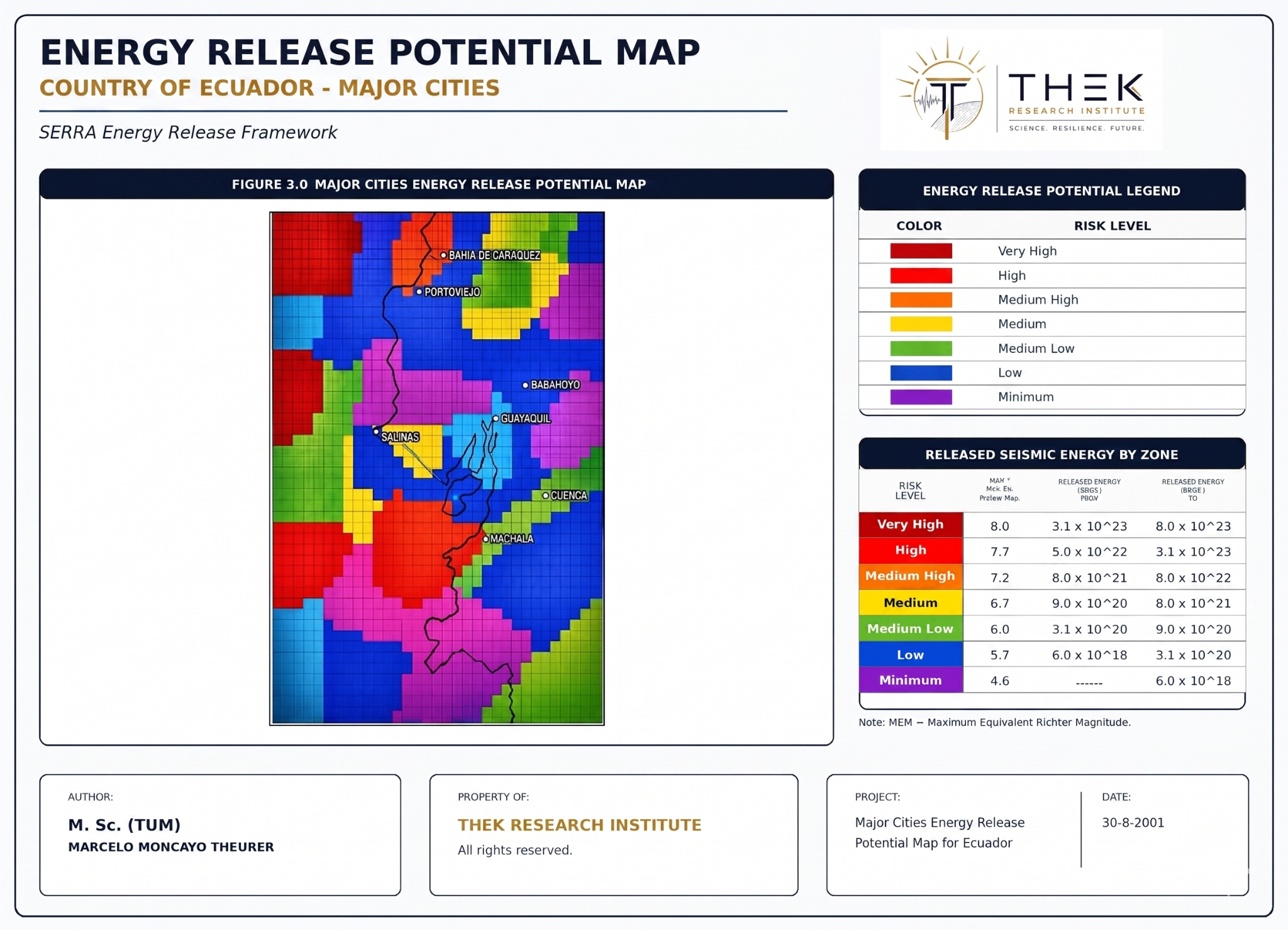
The validation study documents prospective assertions associated with the ESPOL 2005 work, including Manabí–Esmeraldas as a high-risk source zone, later corroborated by the Mw 7.8 Pedernales earthquake of April 16, 2016.
The original scientific paper presented in the United States in 2000, introducing the energy-released approach that later evolved into SERRA/MEL. This work established the concepts of seismic stages, historical energy-release patterns and the 95% energy-release law.
A physical energy-based framework for seismic behavior characterization, reactivation stage identification and seismic risk mapping.
Corroboration of prospective assertions related to Ecuador’s seismic reactivation, the ESPOL 2005 map and the Pedernales 2016 earthquake.
THEK Research Institute is testing an online historical seismic platform that demonstrates the operational direction of the framework.
For collaborations, courses, consulting projects, municipal studies, institutional partnerships or conference invitations, contact THEK Research Institute.
Email: ntndecuador@gmail.com